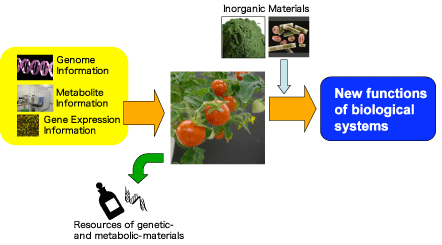
Kazusa DNA Research Institute has determined genome sequences and metabolite compositions of various organisms. Now, our study is shifting from “DNA investigation-phase” to “DNA utilization-phase”. Our research purpose is to develop technology and methodology to make use of genomic and metabolomic information accumulated and to discover new functions of plants, animals and microorganisms.
We are using a vegetable crop, tomato plant, as our primary research material to directly link our results to the applications. Tomato plant is a representative of Solanaceae family to which many vegetable crops, including potato, eggplant, and pepper, belong. In addition, tomato is regarded as a model of fruit formation. By studying a fruit bearing plant, the research results will be utilized readily for the production and storage of bio-materials by plants.
Our approach based on the fusion of the biological functions of plants, animals and microorganisms, and the fusion of organic and inorganic materials is expected to open new perspectives in improvement of crop quality, production of biological materials by plants, and development of novel functional materials.
We are investigating gene expression and metabolite accumulation in tomato plant to improve the contents of potentially beneficial metabolites for human healthcare. To achieve this goal, we mix various strategies including full-length cDNA cloning, microarray, metabolic profiling using mass spectrometry, and metabolite purification. We are also developing a technology to synthesize long DNA and to introduce multiple genes at a time. In addition to tomato, the comprehensive metabolite annotation of more than 30 vegetable crops produced in Chiba prefecture (where our institute is located) is being performed, and a metabolite database is being constructed.
To understand how a number of plant metabolites are incorporated in human body, we investigate the profile of food-derived metabolites in blood and urine of human or mammalian.
Some metabolites are known to interact with proteins, and regulate their functions. To decipher a comprehensive map of metabolite-protein interaction, we are trying to identify metabolites that are bound to proteins by a biochemical co-purification approach or by using reporter assay system.
Nonotechnology has becoming a widely technology in many industrial fields. How can we make nanostructures in plant cells? We start a challenge to construct nanostructures in tomato and rice plants, and to supply inorganic materials necessary for that.